
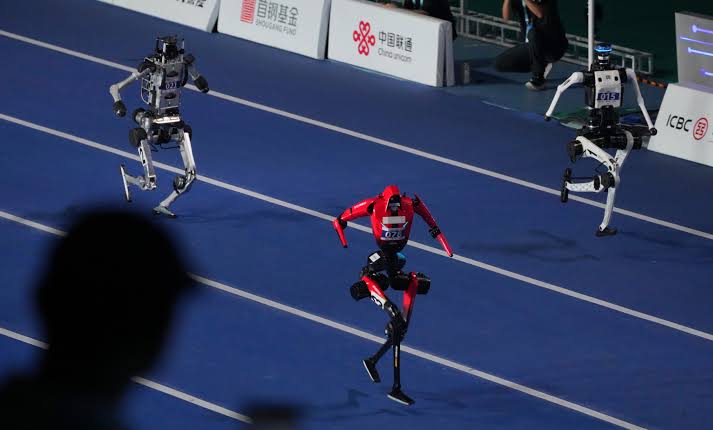
A Chinese humanoid robot has stunned spectators in Beijing after running 100 metres in 9.39 seconds at the World Humanoid Robot Games, beating Usain Bolt’s long-standing human world record.
Tiangong Ultra, developed by the Beijing Humanoid Robot Innovation Center, won its preliminary heat on Saturday in a time faster than the 9.58 seconds recorded by Jamaican sprinting legend Bolt at the 2009 World Athletics Championships in Berlin.
The robot did not have an easy run, however. Tiangong Ultra fell behind early before producing a strong finish to overtake Honor’s Lightning near the line. Lightning also broke Bolt’s record, crossing the finish in 9.47 seconds.

Both machines produced chaotic finishes that were far removed from Bolt’s famous sprinting displays. Tiangong Ultra stumbled dramatically after crossing the line and crashed towards the sidelines, forcing spectators to move out of its path.
Lightning suffered an even more dramatic conclusion, collapsing after the race and eventually being carried away on a stretcher.
Despite the unusual scenes, the times represented a huge improvement from last year’s inaugural competition. Tiangong Ultra won the 100m title in 21.50 seconds at the first edition, meaning its latest performance was more than 12 seconds quicker.
Lightning had already shown its potential earlier in the week, with Chinese state media reporting that the robot completed a 100m test in 9.32 seconds and reached a peak speed of 14.5 metres per second.
https://x.com/Breaking911/status/2091334534667051181?s=20
The robot also won this year’s humanoid half-marathon in Beijing, completing the race in 50 minutes and 26 seconds. Researchers reportedly modified Lightning ahead of the games by extending its legs from 95 centimetres to 1.05 metres.
The 100m is one of 51 events being contested at this year’s World Humanoid Robot Games, with competitions also featuring football, dancing and industrial tasks.
China has increasingly identified humanoid robots as a strategic emerging industry, with government policymakers and technology companies investing heavily in artificial intelligence and robotics.
The growing interest was highlighted this week when shares in Unitree, one of China’s leading humanoid robot manufacturers, rose more than fivefold during its Shanghai trading debut. The surge gave the company a market value of around $50 billion.
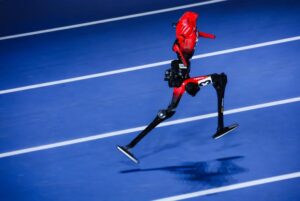
The second edition of the games has also expanded significantly, attracting 2,056 robots representing 666 teams from 16 countries across six continents.
The competition is being held at Beijing’s National Speed Skating Oval and will continue until Wednesday, with the rapid development of the robots expected to remain one of the major talking points throughout the event.