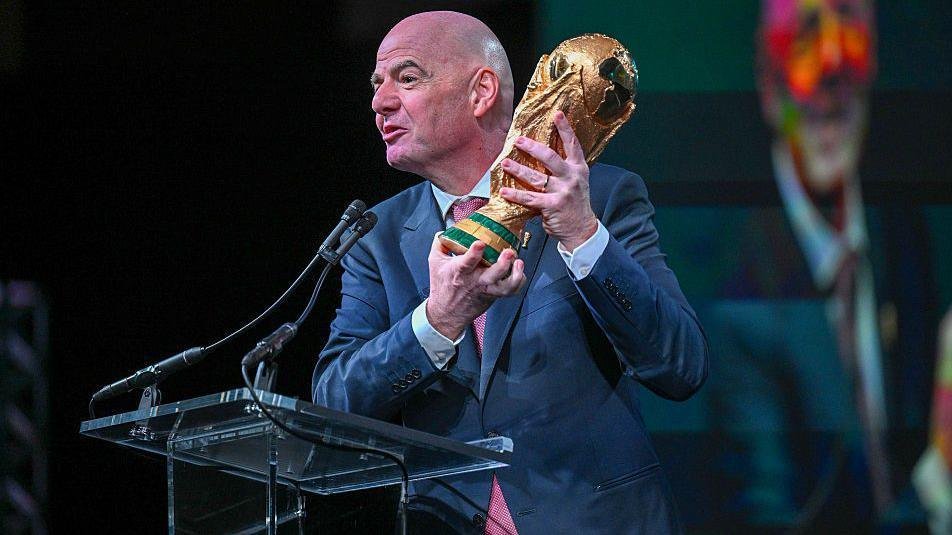
FIFA president Gianni Infantino faced renewed pressure on Monday after UEFA, CONCACAF and the AFC issued a joint warning that football could not be treated as the property of one individual.
The three confederations delivered their strongest criticism yet of Infantino following the collapse of his controversial proposal to introduce private investment into FIFA competitions, including the World Cup.
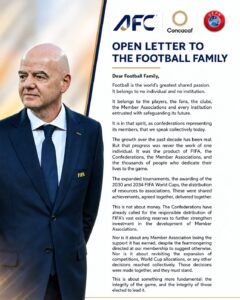
In a strongly worded letter, the governing bodies of European, North and Central American, and Asian football accused the FIFA president of placing himself above the organisations and people who had entrusted him with leadership.
“Leadership in football is not a possession. It is not about holding – or demanding – power to be held,” they wrote.
“When trust is broken through deception, when an individual places himself above the collective that entrusted him with authority, that duty has been abandoned.”
The statement represented a significant escalation in the growing dispute between Infantino and several of FIFA’s most powerful confederations.
Infantino had faced widespread criticism after proposing a private investment structure that would have allowed investors to acquire stakes in a commercial entity responsible for running major FIFA competitions.
The plan was withdrawn within days, with UEFA particularly vocal in its opposition. European football’s governing body had even threatened a potential World Cup boycott if the proposal went ahead.
Such a move could have had enormous consequences for FIFA, with reigning world champions Spain and 2026 semi-finalists France and England among the European teams that could have been affected.
FIFA responded over the weekend by accusing some critics of conducting a “concerted and ongoing effort” to undermine the organisation and its president.
However, Monday’s joint letter showed that the criticism had not disappeared with the withdrawal of the investment proposal.
The three confederations argued that FIFA’s response had failed to address the real problem.
“FIFA’s recent letter to its Vice-Presidents and 211 Member Associations acknowledges that mistakes were made in the process,” they said.
“It treats this as a failure of communication, when what football witnessed was a failure of judgment.”
The confederations also questioned an emergency meeting Infantino held in Morocco, where he received the reported full support of senior FIFA directors.
They argued that the meeting did not go far enough because only a selection of members of FIFA’s Management Committee had been summoned.
“This recent meeting, where a select number of members of the FIFA Management Committee – not the full Committee – were summoned abroad, rather than leadership going to Zurich to address the heart of FIFA, its staff, only reinforces these concerns,” they added.
The latest confrontation could have wider implications for Infantino’s political future.
The 56-year-old Swiss has been FIFA president for a decade and is expected to seek a fourth and final term at next March’s election in Rabat. Candidates must declare their intentions by November 18.
Before the private investment controversy erupted, Infantino had appeared likely to face little opposition after overseeing a successful 2026 World Cup in the United States, Mexico and Canada, the first edition of the tournament to feature 48 teams.
However, CONCACAF president Victor Montagliani is now viewed as a potential challenger.
The three confederations that signed Monday’s letter do not necessarily represent a unified voting bloc, and Infantino still has significant support within FIFA.
The Confederation of African Football has backed him, while CONMEBOL remains broadly supportive. There are also supportive voices within CONCACAF and the AFC, including Mexico, Kuwait and Qatar.
Infantino has also pointed to the growth of the World Cup and FIFA’s expanded tournaments as evidence of progress during his leadership.
But UEFA, CONCACAF and the AFC rejected the idea that those achievements belonged to one person.
“The growth over the past decade has been real,” they said. “But that progress was never the work of one individual.”
They argued that the expansion of tournaments, the awarding of the 2030 and 2034 World Cups and the distribution of resources to member associations had been collective achievements involving FIFA, the confederations and national associations.
Their final warning was particularly damaging.
“Under Infantino’s leadership there is silence where there should be accountability, distance where there should be openness,” they said.
The dispute is now likely to remain one of the biggest issues surrounding FIFA ahead of next year’s presidential election.
With Infantino seeking another term and potential opposition emerging, the controversy over private investment may have evolved into something much bigger: a battle over who controls the direction of world football and how much power should rest with FIFA’s president.
For Infantino, rebuilding trust with some of FIFA’s most influential confederations could now be just as important as securing another term in office.