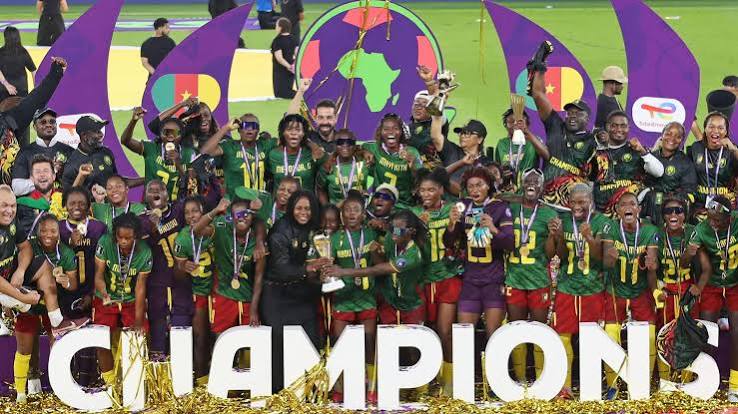
Cameroon finally ended decades of heartbreak by beating Malawi 3-0 to win their first-ever Women’s Africa Cup of Nations title, with Marie Ngah Manga scoring twice and Naomi Eto adding another in a dominant first half.
The Indomitable Lionesses had waited through three failed final appearances in 2004, 2014 and 2016, but this time there was no disappointment at the final whistle. Cameroon produced a ruthless performance to claim the continental crown after an extraordinary campaign that had seen them overcome two of the tournament’s biggest favourites.
Their road to the final had already been remarkable. Cameroon had initially failed to qualify for the tournament but were handed a place following their FIFA ranking and the expansion of the competition agreed in December. They made the most of the opportunity, producing a run that eventually culminated in the biggest achievement in the history of Cameroonian women’s football.
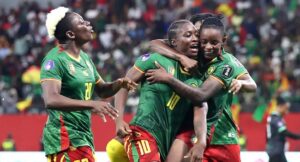
After defeating Nigeria in the quarter-finals and Morocco in the semi-finals, the Indomitable Lionesses faced another surprise package in Malawi, who were appearing in their first-ever WAFCON final.
Malawi started brightly and created the first serious opportunities of the match. Temwa Chawinga caused problems down the left flank, while her sister Tabitha helped create an early opening after sending Temwa through on goal.
Temwa entered the box from the left but found Cameroon goalkeeper Michaely Bihina standing in her way. Bihina quickly came off her line and produced an excellent save to deny the dangerous forward.
Chikondi Gondwe then tested Bihina following a corner, although her effort lacked the power to seriously threaten the Cameroonian goalkeeper.
Cameroon initially struggled to impose themselves, but they showed why they had reached the final when their first clear opening produced the breakthrough.
Naomi Eto delivered a dangerous cross into the box, with Grace Mendoua arriving at the far post to head the ball towards goal. Malawi goalkeeper Mercy Sikelo managed to push the effort onto the crossbar, but the rebound fell perfectly for Ngah Manga, who reacted quickest to fire Cameroon ahead from close range.
The goal changed the momentum of the contest.
Malawi immediately tried to respond from a corner, but Bihina confidently punched the delivery away from danger. Cameroon then nearly doubled their advantage when Eto unleashed a powerful effort from the right side of the penalty area, forcing Sikelo into another difficult save.
The second goal arrived soon afterwards.
Following another corner, Malawi’s defence failed to clear the danger properly. Eto seized the opportunity, producing an outstanding acrobatic finish that left Sikelo with no chance and sent Cameroon 2-0 ahead.
Malawi’s defence was suddenly under enormous pressure, with Cameroon’s attacking players finding increasing space around the box.
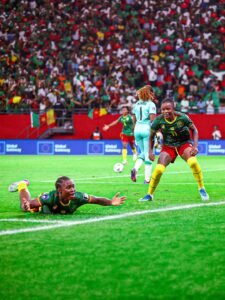
Sikelo kept her team in the contest with another important intervention when three Cameroonian players broke beyond the struggling Malawi defence. Cameroon also appealed for a penalty after a collision involving Eto and Chimwemwe Madise, but VAR did not recommend a review.
Malawi briefly threatened through Asimenye Simwaka, who created panic after winning possession high up the pitch, but Cameroon quickly regained control.
The third goal arrived just before half-time and effectively settled the contest.
Sikelo rushed out of her goal to stop Eto, but the Cameroonian attacker evaded the goalkeeper before delivering a cross into the danger area. Ngah Manga was perfectly positioned to meet it and headed home from close range, completing her brace and giving Cameroon a commanding 3-0 lead at the interval.
Malawi needed a remarkable comeback after the break, and Temwa Chawinga almost gave them hope when she broke forward and struck an effort that narrowly grazed Bihina’s post.
Cameroon then missed a huge opportunity to add a fourth. Ngah Manga was played through by Genevieve Ngo Mbeleck, rounded the goalkeeper and found herself with an open goal, but somehow dragged her effort wide when a hat-trick appeared certain.
Malawi continued to push forward, but Cameroon’s defence remained organised and difficult to break down. The Chawinga sisters continued to look for openings, with Tabitha forcing another save from Bihina after breaking into the box before Temwa missed the target moments later.
Cameroon also had chances to extend their lead. Ngah Manga went searching for her third goal but was denied by Sikelo after another dangerous delivery from Mendoua.
The Malawian goalkeeper remained busy throughout the second half, including when she reacted quickly to stop Eto after the Cameroonian forward had beaten several defenders during a brilliant solo run.
Malawi appealed for a penalty after Mendoua’s effort appeared to strike Tendai Sani’s arm inside the box, but VAR again did not intervene.
Despite controlling possession for periods and pushing players forward, Malawi could not find a way through Cameroon’s compact defence. Bihina also had a nervous moment when she dropped a cross in front of Tabitha Chawinga, but the goalkeeper recovered the ball before Malawi could capitalise.
Cameroon continued to search for a fourth goal until the closing stages. Mendoua headed narrowly wide after another poorly cleared corner, while Gabrielle Onguene appeared to add a spectacular late fourth before the goal was ruled out for offside.
The final whistle eventually confirmed Cameroon’s historic triumph.
For Malawi, the defeat ended a remarkable first appearance in a WAFCON final, but their run represented a major breakthrough for the country’s women’s football.
For Cameroon, however, the night belonged to a generation that finally succeeded where three previous teams had fallen short. After losing the finals in 2004, 2014 and 2016, the Indomitable Lionesses finally lifted the trophy.
Their achievement was made even more impressive by the route they took to the final, eliminating Nigeria and Morocco before dismantling Malawi in the decisive match.
Cameroon therefore completed one of the most unexpected WAFCON triumphs in recent history, turning an unlikely invitation into a first continental championship and ending the country’s long wait for women’s football glory.