
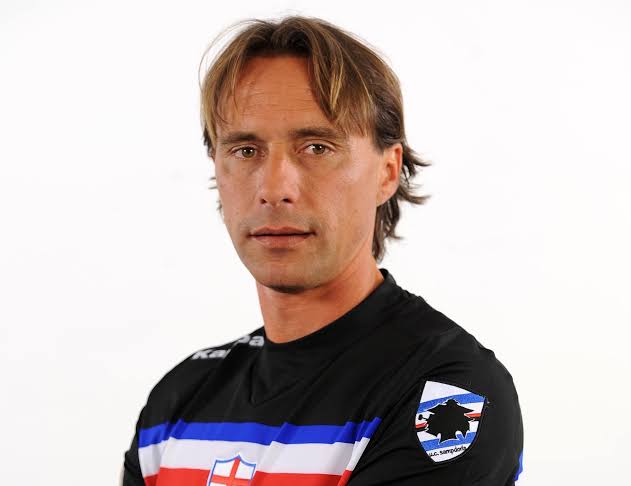
Long before Federico Chiesa became one of Italy’s biggest soccer stars, another Chiesa had already made his mark on Serie A.
Enrico Chiesa was one of the country’s most consistent forwards during the 1990s and early 2000s. His powerful finishing, intelligent movement, and ability to score from almost any angle made him one of the most feared attackers of his generation.
He represented some of Italy’s biggest clubs, earned regular call-ups to the national team, and won major trophies before later watching his eldest son follow the same path.
Today, Enrico Chiesa is recognized not only for his own achievements but also for the influence he had on Federico Chiesa’s development.
Their careers share many similarities, from growing up in Italian football to starring in Serie A and representing Italy on the international stage.
Table of Contents
Enrico Chiesa Biography

He was born and raised in Genoa, one of Italy’s historic port cities and a place deeply connected with soccer. Very little has been publicly revealed about Enrico Chiesa’s early family life.
He has consistently kept his private life away from media attention throughout his playing career and retirement.
What is known is that soccer became part of his life from a young age. He developed through local youth football before joining Pontedecimo, an amateur club near Genoa, where his talent quickly became evident.
His performances eventually attracted Sampdoria, one of Italy’s strongest clubs during that period.
Joining Sampdoria’s youth system opened the door to professional soccer and marked the beginning of a career that would span more than two decades.
Career

Enrico Chiesa made his Serie A debut for Sampdoria during the 1988 and 89 season. Breaking into the first team was far from easy.
Sampdoria had one of the strongest squads in Italy, led by stars such as Roberto Mancini and Gianluca Vialli. Opportunities for young forwards were limited, making regular playing time difficult.
To continue his development, Chiesa spent several seasons on loan.
Loan Spells
Like many young Italian players of his generation, Chiesa refined his game away from the spotlight. He spent time with Teramo and Chieti before later joining Modena and Cremonese.
These moves proved crucial. Rather than remaining a reserve player at Sampdoria, Chiesa gained valuable first-team experience against experienced defenders.
His confidence, movement, and finishing improved with every season. His breakthrough finally arrived at Cremonese.
The 1994 and 95 Serie A season transformed Enrico Chiesa’s career. Playing regularly at the highest level for the first time, he scored 14 league goals despite representing a club battling near the bottom of the standings.
His performances caught the attention of several top clubs across Italy. More importantly, they convinced Sampdoria that he was ready to become a first team player.
Back at Sampdoria, Chiesa immediately established himself as one of Serie A’s most dangerous attackers.
Partnering with Roberto Mancini, he enjoyed the best scoring season of his career to that point.
He finished the 1995 and 96 Serie A campaign with 22 league goals, placing himself among Italy’s leading scorers.
His speed, quick reactions inside the penalty area, and ability to strike from distance made him one of the most complete forwards in Italian soccer.
That outstanding campaign earned him a move to Parma. Success at Parma Parma signed Enrico Chiesa in 1996 during one of the club’s most successful eras.
The team already featured elite talent, including Gianluigi Buffon, Fabio Cannavaro, Lilian Thuram, Dino Baggio, Juan Sebastián Verón, Hernán Crespo, and others during different stages of that period.
Chiesa quickly became one of Parma’s key attacking players. Across three seasons, he consistently delivered goals in both Serie A and European competition. His biggest achievement came during the 1998 and 99 season.
Parma won the UEFA Cup after defeating Marseille in the final, with Chiesa playing an important role throughout the tournament.
The club also lifted the Coppa Italia that same season, completing one of the most successful years in its history. His time at Parma firmly established him among Italy’s elite forwards.
Fiorentina Years
In 1999, Chiesa joined Fiorentina. The move reunited him with another ambitious club competing regularly for European qualification.
He continued scoring consistently despite playing in a squad that experienced significant financial difficulties during the early 2000s.
One of his most productive partnerships came alongside Gabriel Batistuta before the Argentine striker left the club. Even after Batistuta’s departure, Chiesa remained Fiorentina’s primary attacking threat.
His goals often carried the team through difficult periods on and off the field. Lazio Following Fiorentina’s financial collapse, Chiesa moved to Lazio in 2002.
His time in Rome was affected by injuries, limiting both his appearances and overall impact.
Despite those setbacks, he still demonstrated the quality that had defined his career for more than a decade whenever he returned to the field.
Siena
Chiesa found greater consistency after joining Siena. Over several seasons, he became one of the club’s most experienced players and continued scoring important goals despite entering the latter stages of his career.
His leadership proved valuable as Siena established itself as a competitive Serie A side.
The final chapter of Chiesa’s career came with Figline. By then, he had already built one of the most respected careers among Italian forwards of his generation.
He officially retired after more than 20 years in professional soccer. His career totals included well over 200 goals across league, domestic cup, and European competitions, placing him among Italy’s most productive strikers of his era.
Italy National Team
Enrico Chiesa earned his first senior Italy call-up in 1996. His international career coincided with one of the strongest generations in Italian soccer history, meaning competition for attacking places was exceptionally intense.
Players such as Christian Vieri, Filippo Inzaghi, Alessandro Del Piero, Roberto Baggio, Francesco Totti, and Vincenzo Montella were all competing for places during the same period.
Even with that competition, Chiesa became a regular member of the national team across several years. He represented Italy in UEFA Euro 1996 and remained part of the squad through multiple qualification campaigns.
In total, Chiesa earned 22 senior international appearances and scored seven goals for Italy. His international numbers reflected the challenge of competing for minutes in one of the deepest attacking groups Italy has ever assembled.
Even so, his ability to consistently earn selections demonstrated the level he maintained throughout his prime.
Family

Enrico Chiesa has been married to his wife, Francesca Chiesa, for many years, and together they have built one of Italian football’s most recognizable families.
The Chiesas have largely stayed away from public attention. Francesca has rarely given interviews or appeared in the media, choosing instead to support her husband and children privately.
The couple have three children:

- Federico Chiesa, the Italy international winger who has represented Fiorentina, Juventus, Liverpool, and the Italian national team.
- Lorenzo Chiesa, who also pursued football at youth level before continuing his own path outside the spotlight.
- Adriana Chiesa, the family’s youngest child, who has maintained a private life away from professional sports.
Football has always been part of daily life in the Chiesa household. Enrico’s experience as one of Serie A’s top strikers naturally influenced his children’s upbringing, but he has repeatedly explained that he never forced Federico into the sport. Instead, he encouraged discipline, respect, and enjoyment of the game.
Those values became the foundation of Federico’s development as one of Italy’s leading attackers. When Federico emerged through Fiorentina’s academy, comparisons with his father became inevitable.
Enrico consistently urged patience, reminding supporters that every player develops differently and should be judged on his own performances rather than family ties.
That measured approach helped Federico establish his own identity before starring for Italy during UEFA Euro 2020 and later becoming one of the country’s most important attacking players.
Although Lorenzo also played football, he has chosen a much quieter path than his older brother. Adriana has remained almost entirely out of the public eye, reflecting the family’s preference for privacy.