
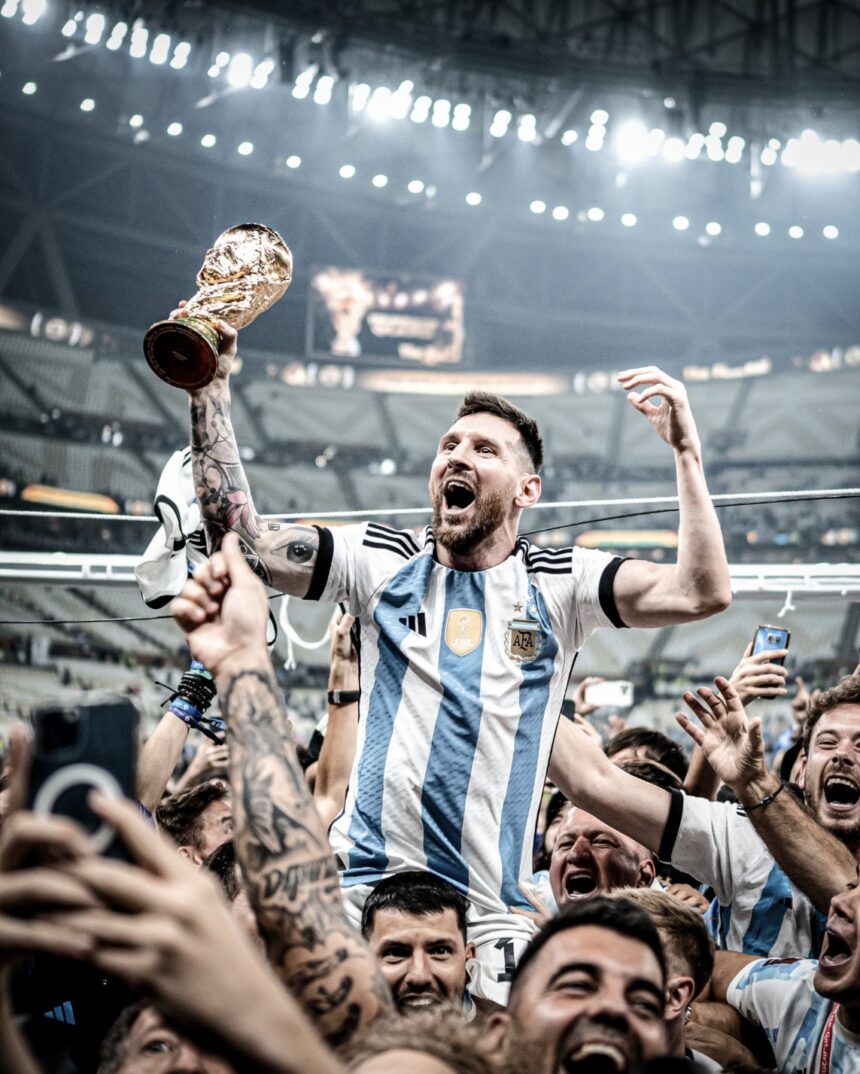
Lionel Messi is set to make his final appearance for Argentina on Tuesday when the World Cup winners face Benin in a friendly, bringing an extraordinary international career to a celebratory close.
The 39-year-old returns to the national team after retiring from international football following Argentina’s defeat in the 2026 World Cup final. Unlike his first retirement in 2016, however, Messi’s latest decision comes after he has achieved virtually everything possible with the Albiceleste.
Messi has won the Copa América twice and guided Argentina to World Cup glory at Qatar 2022 before helping them reach another final in 2026. He will leave the international stage as Argentina’s record appearance maker and leading goalscorer, with Tuesday’s match taking his tally to 208 caps and 125 goals.
From heartbreak to one final celebration


Messi’s journey with Argentina was far from straightforward.
He first announced his international retirement after Argentina lost the 2016 Copa América Centenario final to Chile on penalties. It was his fourth major international final defeat, following Copa América losses in 2007 and 2015 and the 2014 World Cup final defeat by Germany.
“This is tough and a difficult time,” Messi said after the 2016 defeat. “The first thing that comes to my mind and that I have thought is that the end has come for me and our team.”
However, he reversed that decision six weeks later following a huge public campaign urging him to return.
What followed transformed Messi’s international legacy.
The trophies that changed everything


Argentina won the 2021 Copa América, ending a 28-year wait for a major trophy, before Messi finally lifted the World Cup in Qatar a year later.
They then won another Copa América and reached the 2026 World Cup final, giving the forward an extraordinary final chapter with his country.
Much of that success came under Lionel Scaloni, who became Argentina coach after the 2018 World Cup.
Scaloni created a system that maximised Messi’s attacking influence without requiring him to contribute heavily defensively. Argentina’s other players compensated with their work rate, allowing their captain to concentrate on creating and finishing chances.
The results were spectacular.
Messi rewrote the World Cup record book
Messi finished his World Cup career with 34 appearances, the most in the tournament’s history, and became the first player to start three men’s World Cup finals.
He also recorded 33 World Cup goal involvements, another tournament record.

His performances at the 2022 and 2026 World Cups accounted for 22 of those goal involvements, including 10 during Argentina’s victorious campaign in Qatar and 12 in North America.
Messi also scored in nine consecutive World Cup matches, stretching from the 2022 tournament through the 2026 edition.
He briefly became the competition’s leading goalscorer when his double against Austria took him to 18 goals, moving him beyond Germany legend Miroslav Klose.
He eventually finished with 21 World Cup goals, one behind Kylian Mbappé’s 22.
The World Cup ended the GOAT debate for many
However, it was the 2022 triumph that completed Messi’s international legacy.
For years, critics had used his lack of a World Cup winners’ medal to question his status among football’s greatest players, particularly when comparing him with Diego Maradona and Pelé.
That argument largely disappeared when Messi inspired Argentina to victory in Qatar.
The triumph also ensured that the biggest criticism of his international career could no longer be levelled against him: he had finally delivered the World Cup.
Argentina now face life without their talisman


Now, his final appearance against Benin represents the beginning of a new era for Argentina.
Messi will leave the national team having remained one of their most influential players until the end, meaning Scaloni and his squad must eventually find a way to replace a player whose creativity, decisiveness and leadership have defined their greatest period of success.
Argentina have developed a strong collective identity during Scaloni’s reign, but Tuesday’s farewell will provide the first major reminder that their future will no longer revolve around Messi.
Whatever happens next, his legacy with Argentina is secure.
After years of disappointment, Messi finally delivered the trophies his country had been waiting for and gave Argentina memories that could last for generations.