

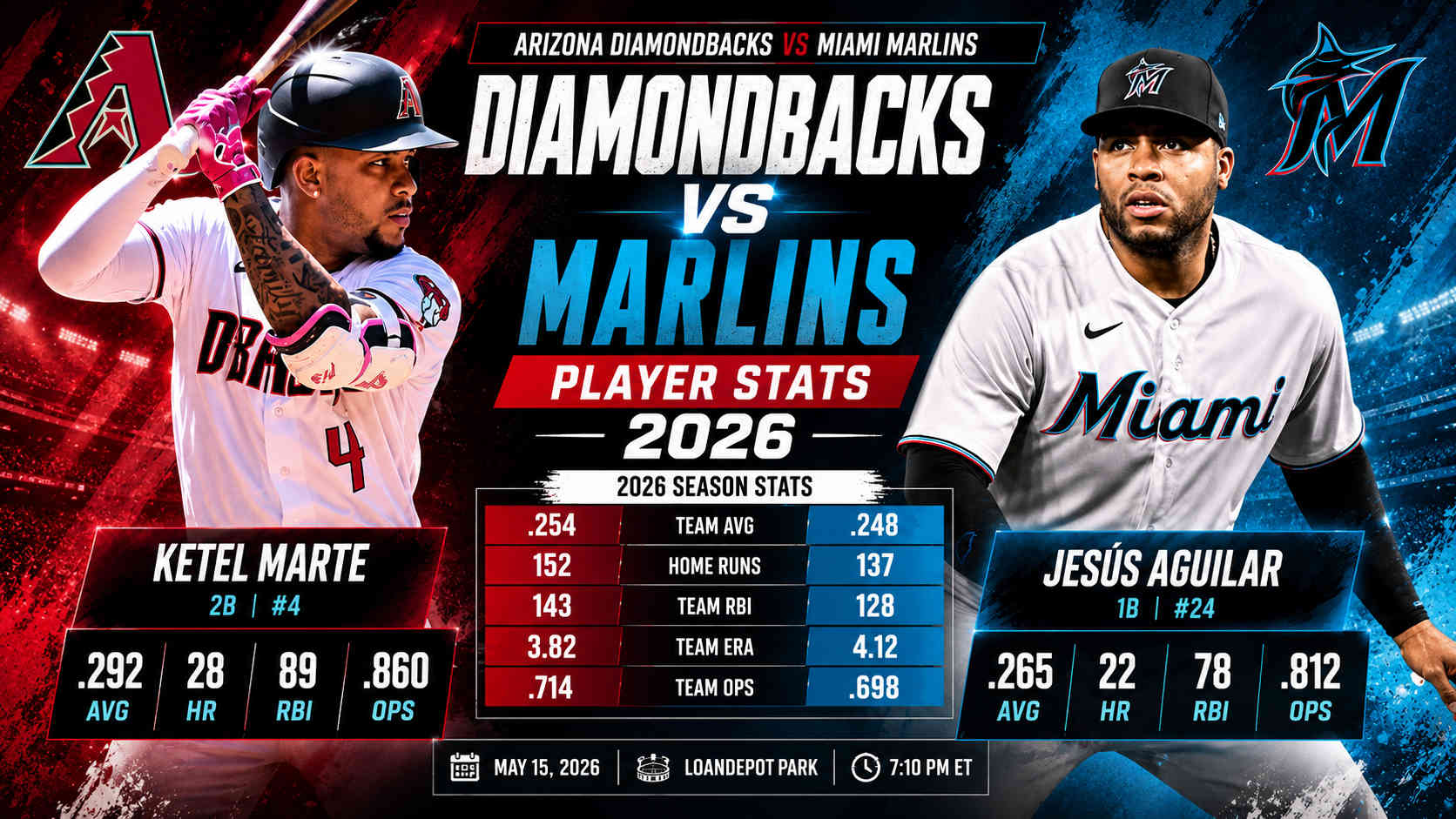
The matchups between the Arizona Diamondbacks and Miami Marlins offer a genuine study in contrast in Major League Baseball: two franchises from different divisions, with different team-building philosophies and very different offensive identities.
Whether they meet in the climate-controlled confines of Chase Field or the coastal atmosphere of loanDepot park, their encounters tend to be decided as much by individual performances as by overall team strength.
Arizona Diamondbacks Vs Miami Marlins Match Player Stats
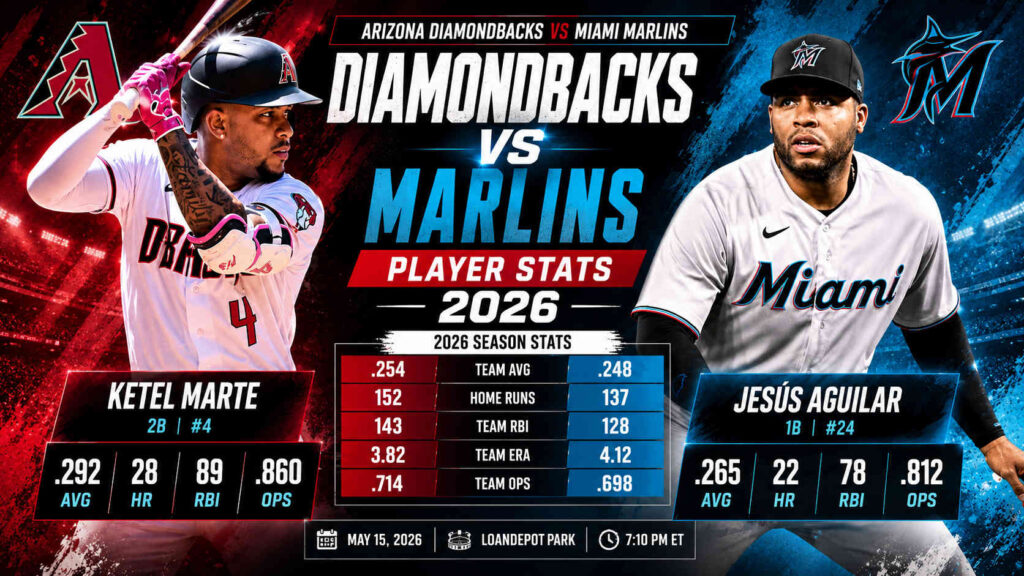

In a series where every inning can shift momentum, the difference between victory and defeat often comes down to the players who consistently deliver in the biggest moments.
For both the Arizona Diamondbacks and Miami Marlins, a handful of standout performers serve as the driving force behind their success, influencing everything from offensive production to defensive stability.
As the season unfolds, these key contributors have emerged as game-changers, transforming small statistical edges into decisive advantages on the field. Whether through clutch hitting, elite defensive play, or leadership under pressure, their impact extends far beyond the box score, often shaping the direction and outcome of the entire series.
June 2026 Series Results
| Game | Date | Score | Winning Pitcher | Losing Pitcher |
|---|---|---|---|---|
| Game 1 | June 9, 2026 | Marlins 10, Diamondbacks 6 | - | Brandyn Garcia (0-1) |
| Game 2 | June 10, 2026 | Marlins 8, Diamondbacks 0 | William Kempner (1-0) | Ryne Nelson (2-5) |
| Game 3 | June 11, 2026 | Marlins 2, Diamondbacks 0 | Tyler Phillips (1-1) | Merrill Kelly (5-5) |
When the Diamondbacks and Marlins meet, the spotlight naturally falls on these influential figures, players capable of altering the course of a game with a single swing, a crucial defensive stop, or a momentum-shifting performance.
Their contributions not only define individual matchups but frequently determine which team gains the upper hand in one of baseball’s most competitive contests.
Arizona Diamondbacks: A Blend of Explosive Speed and Offensive Firepower
The Arizona Diamondbacks have built one of the National League’s most dynamic offenses, combining elite athleticism, disciplined hitting, and game-changing power. Their success against Miami has often been fueled by a core group of players capable of influencing games on both sides of the ball.
Corbin Carroll (RF): Few players in baseball possess the all-around impact of Corbin Carroll. The Diamondbacks star continues to establish himself as one of the league’s premier talents, entering the season with a .275 batting average and an impressive .904 OPS. Carroll’s combination of power and speed makes him a constant threat every time he steps into the batter’s box.
With 13 home runs already on the campaign, he has consistently provided Arizona with extra-base production while also creating havoc on the basepaths through his elite acceleration and instincts.
Defensively, Carroll remains equally valuable. His exceptional range and ability to take efficient routes in the outfield allow him to eliminate scoring opportunities before they develop, making him one of the most complete players in this matchup.
Ketel Marte (2B): As the heartbeat of Arizona’s infield, Ketel Marte continues to provide stability and production at the top of the lineup. His veteran approach, plate discipline, and ability to perform in high-pressure situations have made him a crucial piece of the Diamondbacks’ offensive success.
Marte’s .753 OPS reflects his ability to consistently generate quality at-bats, but his impact extends beyond traditional statistics. Few hitters are more capable of setting the tone early in games, evidenced by his remarkable total of 11 first-inning home runs during the 2026 season.
His knack for delivering early damage often forces opposing pitchers to alter their game plans, giving Arizona an immediate advantage from the opening inning.
Gabriel Moreno (C): While his .277 batting average highlights his offensive contributions, Gabriel Moreno’s true value lies in his leadership behind the plate. The young catcher has developed into one of Arizona’s most trusted defensive assets, serving as the strategic anchor of the pitching staff. Moreno excels at managing game situations, guiding pitchers through challenging at-bats, and maximizing the effectiveness of Arizona’s arsenal.
His pitch-framing ability and advanced understanding of opposing hitters frequently help Diamondbacks pitchers gain favorable counts, particularly during critical late-game moments.
Miami Marlins: Contact Hitting, Versatility, and Emerging Talent
The Miami Marlins continue to rely on a disciplined, team-oriented approach built around contact hitting, defensive flexibility, and opportunistic offense. Their lineup may lack some of the star power found elsewhere in the division, but several key contributors have emerged as difference-makers.
Xavier Edwards (IF): Xavier Edwards has become one of Miami’s most reliable offensive catalysts. Known for his exceptional bat-to-ball skills and disciplined approach at the plate, Edwards has produced a .291 batting average while consistently finding ways to put pressure on opposing defenses. Rather than relying on home-run power, Edwards thrives by creating scoring opportunities through contact, speed, and situational awareness. His ability to reach base and advance runners has made him one of the most important table-setters in the Marlins’ lineup and a major focus for Arizona’s pitching strategy.
Otto Lopez (IF): Among Miami’s biggest breakout performers, Otto Lopez has delivered impressive offensive consistency throughout the season. Batting .336 during his major league appearances, Lopez has established himself as a dependable presence capable of producing in virtually any lineup situation.
His versatility in the field adds further value, but his balanced offensive profile makes him especially dangerous. Lopez consistently uses the entire field, limiting defensive shifts and increasing his ability to generate hits against even elite pitching staffs.
When Miami needs offensive momentum, Lopez has repeatedly proven capable of sparking rallies with timely multi-hit performances.
Joe Mack (C): One of the organization’s most promising young talents, Joe Mack, represents an important part of Miami’s future. Since reaching the major-league level, he has displayed maturity beyond his years, combining disciplined at-bats with a strong understanding of game management behind the plate.
Mack’s offensive upside continues to develop, but his composure in pressure situations has already become evident. Whether handling pitchers or delivering key contributions in late-game scenarios, he provides Miami with another valuable weapon capable of influencing close contests.
Statistical Impact on the Series
The significance of these players extends far beyond traditional box-score numbers. Advanced metrics such as Exit Velocity, Hard-Hit Rate, and Outs Above Average (OAA) help explain why they have become central figures in the Diamondbacks-Marlins rivalry.
Carroll’s power-speed combination, Marte’s run-producing consistency, Moreno’s defensive intelligence, Edwards’ contact skills, Lopez’s offensive efficiency, and Mack’s emerging potential collectively shape the competitive balance between these two clubs.
As the series unfolds at Chase Field, the performances of these key contributors will likely play a decisive role in determining which team gains the upper hand. In a matchup where margins are often razor-thin, individual brilliance can quickly become the difference between winning and losing.
Franchise History: Arizona Diamondbacks vs Miami Marlins


The Diamondbacks and Marlins both entered Major League Baseball during the 1990s expansion era, though five years apart.
The Marlins debuted in 1993, while Arizona joined the league in 1998. Because they play in different divisions, Arizona in the NL West and Miami in the NL East, they meet only a handful of times per season under MLB’s current scheduling format, which tends to make each series feel higher stakes than a typical inter-division matchup.
Their first meeting came in April 1998, shortly after Arizona’s inaugural season began, with the Diamondbacks winning their first four games against the then-Florida Marlins.
Since then, the two clubs have crossed paths periodically, with series outcomes often shaped by which team’s pitching depth holds up better over a short series, rather than any long-standing rivalry dynamic.
The June 2026 sweep fits that pattern: a series defined less by historical stakes and more by which roster’s role players, López, Mack, Stowers, and Caissie for Miami, stepped up at the right moments.
Head-to-Head Stats
While both teams are rooted in different divisions, their rivalry is defined by tactical clashes and evolving team identities. In the 2026 season, these meetings have highlighted the contrast between Arizona’s veteran-heavy offensive approach and Miami’s rising pitching depth and opportunistic small-ball execution.
Recent matchups have underscored the importance of situational hitting. During their mid-June series in 2026 at LoanDepot Park, the Marlins showcased a potent combination of disciplined plate appearances and clutch hitting.
The Diamondbacks, meanwhile, have struggled to maintain consistency away from Chase Field, often finding themselves tested by the depth of Miami’s bullpen, anchored by high-leverage arms like Pete Fairbanks.
The following table summarizes key performance indicators based on the most recent 2026 season encounters, reflecting the competitive nature of these inter-divisional games:
| Metric (Per 2026 Matchup) | Arizona Diamondbacks | Miami Marlins |
|---|---|---|
| Average Runs Per Game | 4.35 | 4.18 |
| Batting Average | .241 | .242 |
| Home Runs Per Game | 0.89 | 0.83 |
| Errors Per Game | 0.38 | 0.70 |
| Strikeouts Per Game | 7.42 | 8.32 |
| Stolen Bases Per Game | 0.58 | 1.15 |
| On-Base Percentage (OBP) | .305 | .320 |
The data indicates that while Arizona often holds the edge in home-run power, Miami’s ability to maximize runners in scoring position and execute defensive fundamentals, such as turning double plays and preventing stolen bases, has proven to be the deciding factor in tight contests.